Thursday, 23 November 2017

Paradise Lost - Delhi Winters

Delhi is no paradise. Delhi is a tough, rough city. Just like a person can be explained in terms of her attitude, traits, values, and beliefs, so can a city. And the adjectives which come to mind for Delhi are not complementary - brash, rude, violent, uncouth. It is like a truant, doped, teenager showing the middle finger whenever someone extends a helping hand or seeks help, who laughs at your shock, who puffs smoke of cigarette in your face whenever you look for any redeeming features. No redemption here. The phrase ‘Dilli dilwalon ki hai’ (Delhi has people with big heart) is nothing more than a wordplay and only slightly more vacuous than the phrase ‘Spirit of Mumbai’.

But, just like in everything, there is a ‘but’. Delhi has some redeeming features (which like most cities in this country, the cities themselves or their governments do not care about). I can list four - (a) wide multi-laned roads, boulevards, and one of the best physical infrastructure in the country; (b) plenty of gardens and green patches including jungles and ridges (one realises their importance after seeing places like Mumbai where a blade of grass is a cause for celebration); (c) food - basically all kinds but the best and most unique are the chats and sweets, in fact the city serves amazing options of the latter (again, sweets are a luxury in Mumbai); and finally (d) winters. I know many people would have personal choices and would like to debate many of these but I find these four to be the best aspects of this city. And lest I sound like a Mumbai-basher, let me admit that Mumbai too has many positives over Delhi (the eternal Delhi vs Mumbai debate) but nothing beats Delhi on these factors.

This piece is to focus on one aspect - Delhi winters, that weather which evokes so many emotions in me that I wish I was a poet, or a better writer. Most of my memories of this city are serenely wrapped in the fog of its winter - winters of catching the school bus in dark and reaching school in light, wearing shorts, freezing but loving it; winters of dark, chilly mornings when life comes alive slowly, like that gently brewing tea on soft flame in the kitchen; winters of eating carrots and pungent radishes in afternoon; winters of dark evenings when poignancy shrouds the heart like blanket and makes one want to remember and cry; winters of day times looking lost and clueless like estranged lovers; winters of early morning wind which can shock and energise; winters when fulfilment is all about staying in blanket the whole day watching TV or reading or writing; winters of riding the bus with open window/gate with sharp wind chilling the whole body still giving a stupid excitement; winters of bus floor littered with peanut shells; winters of shawls, sweaters and jackets, mostly ugly, but at times sharply stylish and beautiful; winters of exhibitions, galleries and All American Diner; winters of open air performances in Old Fort where the chill distracts you but still enhances the performance; winters of picnics in parks and Humayun’s Tomb; winters of deserted streets and Lutyen’s Delhi; winters of endless chais on dhabas while staring at the dark wall that is the jungle of Sanjay Van; winters of half marathons, long jogs and unending walks; winters of hot soups, paranthas, halwas, jalebis, hot flavoured milk; winters of dry fruits; winters of the warmth of motherly love or lover’s embrace. Only a Delhiite can understand most of what I have said.

Delhi winter is a treasure - of memories, incidents, events, longings collected over the age; a scrapbook, a montage, so precious that its loss bleeds the heart. And as of now, the loss looks permanent. And to what? Human folly, lethargy, and procrastination. The last few years have seen Delhi winters witness extreme ambient pollution levels which have made the city a gas chamber. Media coverage has been relentless, especially over the last two years but I know this has been a phenomenon of 4-5 years. So we have foreign nationals refusing to stay in the city, countries issuing travel (non)advisory, social media abuzz with meaningful and meaningless, people becoming half scientists individually diligently measuring air quality index (AQI) and pronouncing the quality as ‘Severe’ and spelling out technical difference between different air masks and air purifiers; and media as well as businesses benefiting from the hysteria by churning stories and products around this situation without any meaningful contribution. All in all India as usual.

The problem is there is no clear, scientific understanding of the situation, at least none that I have found. What has started causing such poor air quality over the last 4-5 years? Is it the case of gradual build-up over the years or has there been some major structural change which has suddenly tipped the scale? In either of the cases, what were the causative factors in order of importance? Is it a problem only of Delhi or also of areas within 100-200 kms range? Is it one major problem or a sum of many small factors? Is farm burning the major issue? Then does it not happen twice a year? Or why was it not a problem say 5 years back? Or are vehicles and construction the biggest contributors? Then why no drastic steps against these? How can cracker burning be a big culprit when it is largely a single day event? Then aren’t these incessant appeals against cracker burning by all and sundry just a case of propagation of thoughtless messages in the garb of sounding enlightened and guardians of greater good instead of actually applying brains? Aren’t odd-even and temporary construction bans classic cases of Indian jugaad or resourcefulness, biding time, waiting for the weather to turn or for the next big story to distract the masses, instead of taking difficult, long-term steps to tackle the problem? Why do we not get more concrete facts, figures and logical explanations from researchers and experts, if at all there is research/genuine thought around the issue? Overall the media, politicians, intelligentsia is more capable of managing the environment around environment than actually tackling the environment problem.

While I know the answers to some of the questions, but I am pointing out the obvious gaps in public thought around the issue, at least going by how it is playing in the media. Long term planning and strong action have never been India’s forte and there seems to be no change here as well. Because nobody wants to take strong, difficult countermeasures which would require sacrifices which are discomforting and painful. The very Delhi population who is crying hoarse (literally) against the pollution will not be willing to not actually reduce their vehicle usage on a sustainable basis, or look to undertake construction activities in a safer manner, or overall be conscious about their carbon footprint. In India it is always somebody else’s fault, and somebody else’s repentance and correction.  
Never mind. My biggest pain is that I have been robbed of my beloved Delhi winters. It is barely possible to step out of home, leave alone enjoying the weather. One can only it to the extent possible to do inside a car. I have decided to inculcate the habit of getting up early, only to realise that I can barely take advantage of this weather which is (or would have been) even more beautiful at that time - I can’t go for long walks or run. I started bicycling in this weather, but had to give up because of a bad chest congestion. Delhi winters are now like a zombie, like a ventilator patient who I am seeing from behind a glass as my own eyes become glass, like a romance which is now un-pure, tarnished, like a reality which has become a dream. Just sit tight, hold your breath, write blogs, and wait for weather to change.   

The world’s a stage
But this play is a joke
You will not exit with a graceful bow

But with an ugly choke

Saturday, 4 November 2017

Newton - Movie Review

Rajkumar Rao had struck me as an actor in Kai Po Che (2013). While it helped that I loved the movie, the earnestness of his acting caught attention. And since then I have followed his growth as an actor with delight. While I have not seen many of movies, I nevertheless get chuffed by his choice of movies. So far he has not been distracted by big banners or big money at the cost of the quality of roles. At the same time his marketability has grown which means he would have some bargaining power and would not get marginalised over time. He seems to have found that special place in the largely mediocre Bollywood where he is able to do justice to his skills, and at the same time command an audience, the kind of space that only actors like Irfan Khan and Nawazuddin Siddiqui have been able to find. The best part is that all three of them are not great looking but you want to see them on screen.

So watching Newton with Rajkumar Rao in lead, with its quirky name, and with rave reviews had become mandatory. And I liked it. I am not using the superlative ‘loved’, and there is a reason which needs elaboration. Right now Bollywood is split into three kinds of movies - nonsense cinema which it has been always making and which it continues to make because it requires limited effort and sells readily. This segment makes for bulk of the output and is liked on a mass scale with endorsement from mainstream actors, primarily SRK and SK. Then there are movies by mainstream stars like Aamir Khan and Akshay Kumar which are commercial but with stronger storyline. They tell a good, relevant story, but in a populist manner. The extent to which they are sugar-coated distances them from reality. And the third category is of hard-hitting stories, which can make one uncomfortable. These are usually slice-of-real-life, reflecting truer version of India. This category of movies has come into prominence over the last decade or two and is the most positive change for Bollywood. Such movies have championed the craft of movie-making. They do not insult intelligence and give emotional satisfaction. Movies such as Dor, Masaan, Kai Po Che, Lootera, Shor in the City, Do dooni Char etc. fall into this category. The key trait is that such movies keep story at the center and the story is not necessarily to please. I am deeply appreciative of such movies and of actors like Abhay Deol, Irfan Khan, Nawazuddin Siddiqui, Vinay Pathak, Ranvir Sheorey, Vijay Raaz, Nandita Das, Konkana Sen Sharma, Richa Chaddha, KK Menon, Shreyas Talpade, Sanjay Mishra, Pankaj Tripathi who have been the trailblazers.

Nevertheless, there is one problem. India is a large, diverse country with many problems - personal and social, as well as a wide set of milieu. Most of the new wave Bollywood now reaps this fertile field - by taking up a socio-cultural-political problem, or to look at a new milieu. So after a point, films such as Ugly, Titli, Raman Raghav and Badlapur start looking similar in that they put light on the dark, grotesque underbelly of a seemingly calm society. Or movies like Dum Laga ke Haisha, Tanu Weds Manu 2, Vicky Donor, Ishqiya, etc primarily celebrate capturing a new milieu with accurate characterisation, dialogues and mannerism. Or the favourite is to show a compendium of parallel stories. So after following such movies for some time, one starts to find a sameness. A totally new ground in terms of content or treatment is difficult to find. In contrast, Hollywood explores way more diverse fields which extend cinema as a craft in terms of story, acting, direction, sets, technology etc - Schindler’s List, Dunkirk, Dark Knight, Blade Runner and so many more.

Newton for me partly had the same problem - it was not actually breaking any new ground. Still it is to be liked for its honest portrayal. And for a novice mind like me, it is good to explore the layers of the movie subtly over time. The premise is similar - a satire on the state of affairs in the country. Here the context is elections - widely touted as our biggest achievement and a show of strength of our democracy; throwing in the issues of clash of idealism with cynicism, authoritarian mistreatment, voicelessness of the tribals, and short-sightedness of Western media. But all these are treated with a very light hand - absolutely no preaching, sermonising or even taking stands.

But for me the biggest strength of the movie is its play on cynicism. Cynicism is a concept which I grapple with and which will get a separate blog post. This movie first takes you on a cynical ride and then mocks you for being a cynic. The central character Newton is an idealist who wants to go absolutely by the book while conducting polls in a makeshift booth in interiors of Maoist land with only a handful of registered voters - mostly tribals. So despite constant refrains, he would personally go there (and not let some cop go and get the votes), set up a proper polling booth, educate all voters on the sanctity of the process, run the polling station till the prescribed hour, and fight with his life to not lose even two votes. After a while, you actually start thinking he is going too far. What is he going to achieve? You stop feeling for him and think he deserved the thrashing he got for being such a pain. What exactly will he achieve by lecturing those tribals on the virtues of democracy and polling? You start to side with the security head - Aatma Singh for being practical. And if the viewers felt like this, the movie says that the joke is on you.

Nearer home, one questions the purpose of such elections. What exactly will be achieved by conducting a fair election when the voters have no clue of the contestants, of the process, and of the consequences? They have a simple life and would just want lesser atrocities from authorities. But the cause and effect of a fair election and democracy hardly seem to apply to them. Will their lives get any better even if the elections were held fairly? Isn’t the process of election here more a case of man-with-the-hammer, of senseless application of a placebo. The desperation of Newton for fairness, which grows over the length of the movie, reaches farcical proportions. What is Newton trying to achieve here? And what exactly did he achieve? We do not know if the electoral sanctity is maintained at the end - the votes could have been tampered with after Newton is beaten. But then Newton is not foolish! Can’t he see what all of us can see? He can, but he has decided to take a stand. He is not a hero, he is just standing for the right without thinking about the consequences. That is where he is showing others off - that the line between right and wrong is not as smudged as we want to believe and that right is worth standing for for its own sake - to escape it by giving the argument of it being inconsequential is to take the easy way out.

Nevertheless, the film also suggests a lighter hand, a patient, wise approach through Malko. Malko too is an idealist, but her idealism is tempered. She suggests to Newton - “Change takes time, jungle took years to grow.” Yes, that too, but the problem is that there is greater danger of cynicism creeping in over the years. Malko also poses this question - to all who care to listen - how well do we know this country. Newton has no clue, and Malko is used to this neglect, of this callous approach.

The writing and dialogues are taut and crisp. My favourite was when Newton questions, ‘Aap ashawadi hain yah nirashawadi?’ and Malko replies ‘Main aadivasi hoon’. Translating into English would rob the beautiful wordplay. The bit role by Sanjay Mishra too is a gem, especially the message he gives on the profound social impact of Isaac Newton’s work - it takes vision to understand past with such clarity. In fact the movie shows him to be the older version of Newton - one senses a natural connection between them. His argument that you are not doing a favour to the country by being sincere and honest, while resonating with Newton’s character, is at contrast with almost everything else in the movie. Converting name from Nutan to Newton established the anti-establishment nature of the central character brilliantly. Or the name of Aatma Singh - was he reflecting the true soul of this country which is cynical, and is Newton standing for something foreign to us?

I would not call out anybody’s acting in particular. Rajkumar Rao, though good, has done what he is easily capable of doing. He gives the automaton appearance, the restlessness, and the fire in the belly quite easily. Pankaj Tripathi too appears to be on easy ground here. But then again, all this is testimony to the skills of these actors.

The problems shown in the movie are wide, multifarious and messy - with long lineage. One can make many sequels or versions of such a movie, but still not achieve much more. At the end, the movie leaves thoughts and questions in your mind. The answers are tough, personal or non-existent.

Tuesday, 24 October 2017

Blade Runner 2049 - musings

This is going to be a long post! And it is not a movie review because I am incompetent, intellectually and artistically to analyse such movies. Also, this post has many flights of fantasy which, to anybody with some knowledge on the subject, show my absolute imbecility, and ignorance. As the topic line goes, these are ‘my’ musings. I am not sure that not having read Alvin Toffler before writing this is a good thing or not.

Thank goodness I had seen the original Blade Runner 1982 on laptop a few days back. I was prepared to watch the latest Blade Runner 2049, which got released to great critic reviews. I have never been able to appreciate completely cerebral movies like Interstellar or Inception because I am not knowledgeable enough to understand the concept fully, nor do I have the imagination to understand the world beyond the way I see it. So to bolster my appreciation of such movies, I read storyline and detailed reviews. Of course, it dilutes or moulds my own unadulterated view on the movie. But it is better than not understanding most of the movie. So I read review of Blade Runner 1982 after watching the movie to know if there was anything deeper that I had not understood. On reading the reviews, I realised that while the movie had deep connotations but it was more appreciated for its path-breaking vision of the future world and its technical finesse. People of my generation who have grown up on many future-gazing movies with designs of how people, cities, automobiles, gadgets will look like would find it a tad difficult to appreciate that Blade Runner 1982 was path-breaker in the genre. It gave the first blueprint which the later movies built on.

Visionary presentation aside, Blade Runner raises important existential questions. And I admit upfront that I dare to plunge into this discussion without adequate conceptual understanding, or reading of literature on the subject, including novels by Philip Dick (on whose novel ‘Do Androids Dream of Electric Sleep’ this movie is based); and without the philosophical bent of mind. Nevertheless, my one and half cents. The premise is that of a future world where a powerful corporation has created bioengineered robots, or androids, whose advancement has pitted them against humans. Mind you, what we are talking about here is many steps ahead of Artificial Intelligence or AI as is is vogue nowadays. It is not just about machines becoming intelligent, it is about machines becoming more and more human-like. The movie calls these androids replicants.

Blade Runner 2049 shows the world few decades after the first edition of the movie. From the violent, outcast replicants of the first movie, replicants now are more docile, have become part of the mainstream, and do not have a fixed life span.

Difference between humans and machines

To me, the key idea of the Blade Runner movies is to question the differences between humans and machines. In every frame, every dialogue, the movies bring this issue to the core. Further as a corollary, the movies question ‘what makes humans human?’ And then it attempts to debunk all possible answers. The idea of intelligence being a differentiator has been long rested, we are way past that in these movies - replicants are as intelligent as humans, if not more. The movies explore the possibility of machines acquiring more complex human-only preserves such as emotions, memories, experiences, even reproduction. So we have replicants who are crying when they commit a crime, replicants with planted memories, replicants who feel love, desire sex, even sacrifice.

In Blade Runner 2049, to me the most intriguing part was the relationship between K, a replicant and Joi - now how to explain her - she is the embodiment of a computer program, a hologram. The movie seems to be challenging the viewers - ‘In case you were disbelieving androids, here is a hologram which can behave like humans. So Joi fills up for a wife to K - possibly satirizing the price we humans put on relationships. And she ‘learns’ to be as good a wife as she can - tries out new dishes, changes her clothes as per K’s mood, not just arranges for a prostitute - so that K can have real sex - but also superimposes herself on the prostitute to give K the best of both worlds. It does not stop here - Joi is also processing information, analysing the events as they unfold and discussing possibilities with K. And when the danger is near, she is willing to sacrifice her existence so that K’s life is not compromised. There is a scene where K is about to kiss Joi in rain (the edges of the hologram jar slightly when the raindrops fall), and just then his phone rings and Joi’s image freezes and K (a machine himself) wistfully realises the futility of loving a hologram. It is like the director is showing the boundless possibility of a machined life and yet pointing out the limitations.

At all times, replicants behave so much like humans that it is difficult to differentiate between the two. For people like me who are not submerged in the world of sci-fi, AI and cybertronics, it is strange to see such machines. I am not able to fathom how does a machine cry? While Blade Runner 2049 is premised on the concept on replicants reproducing, I think that is only where you draw the line on the possibilities. Replicants having sex is unbelievable enough, the fact that they reproduce is just an extension. Ironically, it appears that there is a race between humans and machines to reach to the other end of evolution - just as replicants want to become more like humans, humans are becoming heartless like machines.  

What gives humans superiority? Is it possible that we are all replicants of another world?

Increasingly, Blade Runner has characters for whom it is difficult to decipher whether they are humans or replicants (the famous puzzle of whether Rick Deckard, central character of Blade Runner 1982, is human or replicant). More interestingly in Blade Runner 2049, K, at one point, doubts that he is not a replicant but a human. This again goes back to the central question - what makes humans human? Can all those things which make us human be ‘replicated’? And further, if we make something with all replicated features, is it not human?

Inherently, I believe there is a superiority complex in humans and we treat everything else (machines, animals) with disdain for being under-developed, on parameters we are not sure of. In fact, this superiority complex may be the root of our complacency and thus our fall. Why do we have this superiority complex? Possibly because collectively we have not been beaten as yet.  Another offshoot of the superiority angle is - is it not possible that we are replicants to ‘humans’ of some other universe, humans who are more evolved than us on totally different parameters. What can be those parameters? I have no clue. Are all the possible parameters which can define something a finite set? I know I am bordering on questioning what defines ‘life’ or ‘live’ forms. But what the heck - for all we know Earth may be an off-world of another world.    

Can humans and machines peacefully coexist?

Whatever sci-fi I have seen around evolution of machines sees them as taking evil form, once fully developed. They would enslave, or completely eradicate the humans. To me, Blade Runner raises the possibility of peaceful coexistence. What if humans get out of their superiority trap and see developed machines as inevitable. In a sense, humans need to accept that just like we start with a clean slate and learn everything from our birth onwards, then why to hate machines learning gradually?

Can the two reach a pact to live together. One argument is that humans, over more than 5000 years, have not been able to live peacefully amongst themselves, it is difficult to have hope for them living with replicants. So, what if the world has only replicants? Given the reducing differences between them and humans, there does not appear to be much of loss. But can the cycle turn again? Can the world comprised only of replicants see the development and overtake by another kind?

Why does the future always have to be grim?

I think that deep inside, most people are optimists. Otherwise life itself is not possible. Even if this hope is not for oneself but for one’s progeny or for the future generations. Anybody who plants a tree hopes that it will flower and bear fruit long after he is gone, many scientific journeys are undertaken despite knowing fully that they will not bear results in one’s lifetime but on the hope that the next generation would take it up. The act of raising a child is premised on hope for a better future for them. When one goes to sleep, one is hopeful of waking up alive, mostly. Just imagine if populace at large is totally hopeless about the future, the society and the life as we know, would collapse. Of course, survival instinct is a strong tenet as well, but that alone cannot take humanity far. Hope is essential.

But seeing all movies which gaze into the future, it is easy to lose hope. All of them portray a grim world. The common themes which play across such movies (Blade Runner, Mad Max, Children of Men, Hunger Games, Equilibrium, Wall-E, Minority Report) are - authoritarian governments ruling with the fist and distant from the masses both literally and figuratively, over-indulgence of technology, cities filled with grey towers, masses which are famished and grisly, large tracts of barren land, absence of any greenery or natural beauty, large metal junkyards, ghost devastated cities, no laughter, only a sense of survival instinct. These movies inspire no hope. They only talk of a world where most human traits like love, empathy, sympathy, happiness, hope have been crushed.

But why is most future prediction so pessimistic. I was reading the book Civilisation by Nialll Ferguson which mention how many Christian religious texts talk about an impending apocalypse, how many thinkers talk about civilisations containing within them the germ of their destruction, as an example - The Course of Empire paintings by Thomas Cole. There is a cyclicality to the whole thing - cycle of destruction and resurrection.
Put it another way, why is past always rosy?

To deviate slightly, I have a felt a preponderance in people to view past more favourably than the future. I am not necessarily contradicting my initial argument of people being optimists, just that past is largely loved. It is not unusual for those of certain vintage to feel that most things - life, emotions, habits, values were better in their heydey. In fact that was the message that I took from the Woody Allen movie ‘Midnight in Paris’. The central character, in 2010 travels back in time to 1920, the period he loves more than his present. In that period, the characters are more appreciative of 1800s. We attach beauty to nostalgia, to memories. This is my side theory - apart from really horrific events, we tend to forget, or at least overlook, painful events of the past. The human mind is eternally satisficing, looking for things to hold on to, and it is very difficult, emotionally sapping, to hold on to pains of the past. We like to hold only to beautiful events of the past.

Old and new will always joust - I think it is more about how that conflict is managed. Increasingly the conflict is becoming violent. The pace of change has increased over the last few decades which people find difficult to keep up with. It is an accepted fact that generation changes in 10-15 years instead of longer earlier. I find people around me mostly exclaiming - ‘how glorious yesteryears were’, ‘in our times, things used to be so better’, or ‘we are living in such depraved times!’. I think people accept material improvement but think that the value system has degraded. Life has seemingly become more complex than what is used to be.

Is technological progress inversely related to moral and value systems?

Cutting aside the rhetoric in India around degradation due to increasing western influence, is there some merit in seeing the moral effects of technological progress? I believe there is and that is the price we pay for a seemingly better life. Born in 1982 and growing through the last three decades, I feel I have seen a period of very rapid change which has been out of grasp of everyone. Most of this change has been technological, mainly in the mode of communication. Television, telephone and internet have been at the center of the change and these changes are so closely spaced that people have found difficult to catch breath and realign the social structures.

Despite all the developments purportedly to ease life, people now complain of ‘fast life’, ‘paucity of time’. Social connections are reducing and becoming tenuous. Mobile and internet allow us to get most work done without having to interact with anybody (in fact most business models nowadays are built around reducing the need for human interaction). Over the years, the smallest social unit has reduced - from a village few centuries ago, to a neighbourhood, to a family, to an individual now. And the gradations of the society have increased - from relatively flat structures to long hierarchies now.

Another impact of the technological progress is the information overload which is having huge social and political repercussions. While it is good to be more informed, there are two downsides - a) more information means more noise also, and b) decreasing levels of faith or trust. The level of exposure which anybody is exposed to has increased manifold and this assault on senses has the tendency to confound than to make things simpler. Lot of information that one gets is either useless or incorrect or misrepresentation - to sift through all this requires greater skill which is not easy for anybody. So it is common to hear refrains of young kids being exposed to objectionable material, or to find governments going to great extremes, even violent at times, to prevent ‘sensitive’ information becoming common knowledge. More information, and the increasing amount of junk and misinterpretation that comes with it, also makes it difficult for people to trust, to be able to take anything on face value without reading about it on the internet. And there is lesser need to collaborate, to talk, to negotiate, thus lesser personal touch. All this is creating a fragmented, antagonistic society. Increasingly the society is grappling with the issue - balance between free flow of information, which is seen as the cornerstone of an evolved society, and the downsides of information overload. Then there is the challenge around human rights - does it apply to one person or to a  mass? At the same time, I admit all these are not necessary apocalyptic - societies have the ability to correct its course, but one never knows for sure.

And other problems..

I am sure less percentage of population now dies of epidemics or diseases then say 500 years ago. Further, I had read long back that we are living through a period of relative peace than ever in our history. This is counted as deaths through murders, armed conflicts, wars etc. These factors, along with increasing life expectancy, means we have a larger population to manage. And the increasing expectations of material comforts mean we need more resources. All this is putting stress on the resources and the environment, as we understand it now. Thus all the hue and cry. We are emitting more pollution; generating more non-recyclable waste; while we are comfortable with respect to most minerals, water resource is a concern; and the overall concern around making irreversible changes to weather cycles, geology, flora and fauna which can have sweeping, non-fully-comprehensible impact that would require undoing some bit of thousand years of evolution in order to survive.

And then there is the problems of political and economic systems around the world. After much trial and error over centuries, the world has largely settled on democracy as the standard way of government and capitalism as the de-facto economic model. While these are the best we seem to have, they are not without challenges. There has been a periodicity of financial meltdowns which creates huge financial and social instability; unequal distribution of wealth stratifying the society; control of resources by a few and growth of mega corporations. Further, the politics keeps oscillating between right-wing orthodoxy; left-wing egalitarianism; liberal carelessness; intellectual partisanship, each of which poses threats.

And I am not in a position to discuss the psychological implications of the way society is unfolding - incidents of road rage, student suicides, domestic violence, sexual assault, paedophile are some pointers. So is the increasing narcissism of the masses.

Is there a tipping point? Can we predict it? Can we avoid it?

Apocalypse can have many forms, but there are usual suspects for causal factors - nuclear holocaust triggered by a shaky hand on the button or declining trust; environmental disaster which is gradually boiling and which can turn for the worse; and of course the rise and rise of machines. Will the apocalypse happen in an instant - like a nuclear bomb, or will we reach it gradually - one sure step after another? I am not capable to answer. More likely, it is gradual with a tipping point which comes relatively suddenly. I find the parable of ‘frog in boiling water’ very interesting. Put a frog in boiling water and it will jump out instantly. Instead put it in normal water in a pot on fire and heat the water gradually, the frog will not jump out but will slowly burn to death. Are we all like frogs, burning slowly to our doom?  

Going into rise and fall of civilisations is a large study which I would not get into here. But in current times, to me it seems like we are on a path of progress which will eventually lead to the scary state portended by many futurists. I definitely feel that there are genuine concerns, the three gravest as per me are - technological (machine invasion), environmental (say an ice age), and socio-political (nuclear war/big-daddy). We are past the age of innocence, and there is greater cynicism and antagonism in the air. We are creating mega corporations which threaten to challenge individual freedom and free will some decades down the line.

Before I proceed, let me admit that a lot of what I say may not hold. One way to check is to compare the present with the prediction of this period made in the past. For eg. the original Blade Runner talks about the year 2019 which is just two years away but it will be nowhere as diabolical as the movie predicted. And we certainly will not have replicants or an off-world by that time. Or the novel 1984 by George Orwell published in 1949 predicted a dystopian future which eventually did not turn out ‘as’ bad. But fundamentally we may just be questioning the pace of change - the change itself is not being challenged.  

The real ordeal is that despite understanding a knowing a lot of it, it still seems inevitable. It is difficult to get off this path. While one would want a balanced approach - advancement without its pitfalls, it is a utopian wish. Technology will progress and it is difficult to say that only so much and no more. Nor is it possible to thresh good from the bad easily - it is a moving goal really. I believe there will be a tipping point, when we go off the cliff but only by experiencing apocalypse will we know that it exists - there is a degree of fatality to it.

Do any rules hold? What is future? Is it everything that we can make?

Sunday, 8 October 2017

Systematic Withdrawal Plan - Saving Tax on Debt MF

When one is looking to park funds safely and generate reasonable risk-free returns, bank FD is at the top of the options. But the biggest deterrent against FDs is the high taxability, especially for those, like me, falling in the highest tax bracket (30.9%). Returns on bank FD, i.e. interest, is entirely taxable in the hands of the investor for the entire period of holding and redemption.

To beat this, one looks for instruments which offer similar safety but with lower taxability. Enter the frame, debt funds. These are mutual funds schemes which invest in debt instruments of various nature, tenor, risk and return. Such instruments can be Central government bonds, state government bonds, corporate bonds, commercial papers, Certificate of Deposits, floating-rate bonds etc. Taxation on debt mutual funds is split between tax on Short Term Capital Gain (STCG) and Long Term Capital Gains (LTCG) where in short term is defined as 3 years and less. STCG gets added to the normal income of the investor for taxation similar to FD, and thus taxed at 30.9% at the highest slab. LTCG is taxed at 20% but with indexation, which means that the principal value is indexed at the rate of inflation (as per the Cost Inflation Index (CII) published by the Government of India) and only the returns generated over and above this indexed value is taxed and that too at 20%.   

So, prima facie, debt MFs can give higher post-tax returns if the tenor is more than 3 years, else their returns are similar to bank FDs (assuming similar risk profile or nominal return). This can dissuade many investors, including myself, who look for debt MFs with shorter tenor or those that give steady cashflows (similar to interest on a bank FD). In fact longer tenor in debt MF can lead to higher risk as there is probability of some of the inherent investments (say corporate debt) going bad.

Purely out of tax dis-attractiveness, I have been wary of debt MFs. But recently, I came across an option in debt MFs which can give steady cashflows in the short term with lower tax incidence than FDs. Mind you, this specific case is applicable if you are looking for debt MF investment from a shorter term perspective. If the investment horizon is beyond 3 years, than debt MFs would automatically give superior post-tax return than bank FDs of similar annual return, because debt MFs have tax rate of 20% with indexation. So the feature under discussion is the Systematic Withdrawal Plan or SWP. This is withdrawal (more accurately redemption) of a fixed amount of money at a fixed interval from the debt MF (equity MF also have SWP option but that is not under discussion here). The interval can be as frequent as per month. (Caveat: my entire premise of this blog post is based on reading of certain websites. I have not been able to verify this from more authentic source say a mutual fund itself. But I have invested in debt MFs based on this)

Each withdrawal from a MF means redemption of units which at the prevailing NAV of the fund equate to the SWP amount. The capital gains incidence is calculated on each SWP. But importantly it is calculated only on the units which are redeemed and not on the entire units held (including balance units). This leads to much lower taxable capital gains, or taxable STCG. What this essentially does is that it is pushes the capital gains to later periods. And assuming that an individual is willing to hold the investment just one day beyond 3 years, then his tax incidence (which includes the tax on capital gains that he has saved from prior years) would reduce drastically.

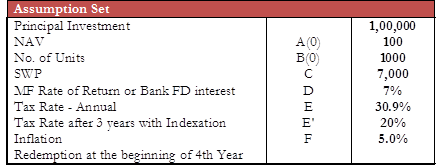
It sounds a bit cryptic, let me present some worksheets.


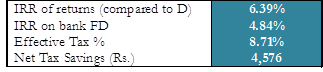
The concept here is that the debt MF has an effective p.a. rate of return (which is equated to a bank FD rate, or the opportunity rate) and we decide to withdraw a specific amount (SWP) every year. And the entire corpus is withdrawn 1 day after the end of 3 years so that the investor falls under the tax bracket of 20% with indexation (beyond 1 day after 3 years would make no difference to the calculations). The end result being judged here is the effective tax rate on the debt MF which in the base case above is 8.71%. Remember, our benchmark is 30.9% which is the effective tax rate on bank FD. Lower tax incidence than this is a saving to the investor, also shown in value terms (Rs. 4,576) above for a Rs. 1 lakh investment.


One trivial case is to set the SWP to 0, which means we are withdrawing the entire investment in bulk at the end of 3 years, and this case would get the lowest tax incidence because no capital gain is getting taxed at the effective rate of 30.9%. Just that that may not be the goal of many investor and the purpose of the whole exercise is to find an alternative to that.

Remember, this model would serve limited purpose in case a very high amount of the original investment is redeemed before 3 years, because in that case, returns are taxed at 30.9%. Mathematically as long as even a small amount is not redeemed after the third year, the return would be superior to bank FD but the gains would not be much. The idea here is to suggest an option wherein ‘some’ periodic cashflows can be generated with some tax savings.

Scenarios are presented below:

   
Some notes from the scenarios:
  1. The left top-most cell in first scenario table shows 0% tax incidence because here no amount is withdrawn and rate of return is same as rate of inflation (assumed), thus there would be nil gains after indexation.
  2. As SWP amount increases, tax incidence increases because greater amount falls under 30.9% tax rate.  
  3. For higher MF return rate also, tax incidence percentage increases because we generate higher returns than the inflation rate which increases the post-indexation gains.  
  4. Our benchmark IRR on bank FD is 4.84% (7% * (1-30.9%)) and each of the case above would give a higher IRR.

To conclude, I have presented a case wherein one can generate higher post tax returns from debt MFs. Agreeably, this works in specific scenarios and may not make an attractive proposition from every investor - especially those looking to increase returns in shorter investment horizon. But it does for me.  

Tuesday, 26 September 2017

Power & Pride

I like to read about - articles and interviews - successful people. In any field - sports, movies, arts, business. It is a much better learning experience than reading self-help books, listening to motivational gurus, or worse, following any Godman. Genuine achievements give semblance of authenticity and trust to what successful people say, unlike in case of others, where it may be empty talk. Also, there is greater objectivity as there is scope of judge, in my mind, the veracity or lack thereof of what such public personalities say.

The quality of an interview depends on the the questions asked. Many interviews are sycophantic, turning into advertisements. They are structured to glorify a cause or the person. Or the interviewer is subservient, fearful of posing uncomfortable questions. This is emphatically true in case of the Indian media, partly as a result of our tendency to accord divine status to celebrities, thus above all reproach; as well as our innate difficulty in challenging authority - deserving or perceived.

Now that I have rambled, let me come to my core issue. When I see interviews of successful people, I wish the interviewer would ask a personal question - “How do you handle power, money, and pride”. Facets of money, power and the arrogance that comes with it engrosses and perplexes me. A famous quote goes “Power tends to corrupt, and absolute power corrupts absolutely”.

Power is the ability to influence or to control. As per me, power has three possible sources - a) Money, b) Position, and c) Knowledge, talent or artistic skill. All the three sources of power that I enlist can be used constructively and for ‘greater good’, if there is such a thing. The power derived from ‘knowledge’ or ‘talent’ has fewer instances of being abused - Hiroshima bombing being a real-life example apart from all the mad scientists in Marvel comics. But power derived from money and position is summarily abused. The thing is that the line between good use and abuse of power is blurred. It is a difficult balance, to me, almost beyond the control of humans.

Over time, the societies have come to accept abuse of power as human nature. It is an elevated level of thought and consciousness to not implicitly accept abuse of power. I am not sure if any society has achieved that level of consciousness. Indian society has indeed not. The extent to which we expect and accept abuse of power is startling. Some part of it flows from the fibre of this society where people in power are exalted - what I call the ‘mai-baap’ syndrome. Indian population can be extremely subservient to those in power which induces abuse of power (just like how many famous rock stars easily fall into the trap of womanising because female fans willingly throw themselves to them). And the expectation of power-abuse has only deepened over the years. It is assumed that a politician would use his time in power to amass disproportionate amount of wealth; that near and dear ones of those holding prominent positions would secure jobs/contracts easily. It is only when power abuse goes to criminal extent that we are jolted (that too not always), else we are ok.

I find the Indian society increasingly obsessed with money. While there are communal and geographical disparities to this, the community I inhabit has nauseating obsession. Money is important - to have material comforts, for good health, for peace of mind, for freedom, both mental and physical. I don’t deny that poverty is a bane. But the distinction is not between poverty or absence of it, it is rather about the greed for more wealth. Indian society is increasingly placing greater premium on wealth above all virtues. Virtues like honesty, integrity, determination, courage, knowledge, wisdom, benevolence, lawfulness, charity are losing importance to the power of wealth. And increasingly, the society is comfortable with it. There seems to be no conscious repentance for this behaviour. Again it is not about willingness to live in poverty, instead it is about senseless greed. The line between the two is thin and it is hard for a person to know when he has transitioned from running away from poverty to chasing wealth. As the lifestyle expands with wealth, the definition of poverty changes. What was luxury yesterday becomes a necessity today. Nevertheless, I believe that man, as a conscious being can distinguish between the two. But there is a another aspect to this - whether your society places wealth at the high pedestal, it judges those without it as non-ambitious or failure. Then an individual’s choice is limited but to get into the race.

In the world I inhabit, it is very usual and expected that any interaction between two individuals entails each judging the other person’s wealth. Cues such as attire, gadgets, jewellery, vehicle, address etc. are closely noticed. Because wealth can be so easily quantified, analysed, trended, it is a much better tool (than other intangibles) to compare people, to rank order, to compete, and to define success and failure. To many Indian readers, this may seem like harping on the obvious. I have met so many people who get appalled when I mention this, the look on their faces saying “Isn’t it obvious?”, “What’s wrong with it?”, “You are naive”. Indeed, I feel naive very often. But I have read enough that this has not always been the state of affairs. Many societies - Indian and others - have at some point attached importance to ideals other than money. Infact, amassing wealth had been viewed as abominable by many.

The hatred of chasing money can have two interpretations - a) genuine hatred and belief in valuing higher virtues, and b) false hatred emanating from weakness of character - hatred for money or money-grabbers because oneself is not capable of it. I am not sure where I fall.

Agree that there is a degree of virtue also in chasing money - it gives birth to ambition, which can be the seed for many good things including progress. Many industries, and businesses owe their existence and success to somebody’s desire to become rich. These businesses serve the needs of the society as well as uplift people out of poverty. It is hard to imagine how the civilisation would have advanced had the humans not been greedy. At the same time, I have two counter arguments -
  1. At the heart of most progress is the desire to solve a problem, to innovate, to make things better and to help humanity at large. That is when society gains the most.
  2. Even if greed is at the heart, it should stop up to a point, after which other virtues should take greater importance (similar to the ashram system proposed in Hinduism). What that level is highly subjective and difficult to define for most people.

To expand the second point above, the problem is not with chasing money - it may be a greater travesty to not do justice to one’s ability. The problem is chasing money at the cost of higher virtues. Chasing money inherently breeds vices, narrows thought, weakens and distorts people out of their natural form, takes pleasure out of life as it is, consumes mental space with constant comparison and envy, prevents appreciation of non-material virtues in others. All a result of the power that the money allows them.

Power, as I said, can also come by way of a position or rank and that too is an attraction for many. Many positions in bureaucracy or in state-owned companies do not give great financial rewards (at least not legally) but compensate for the same by way of positional power. The universal love for recognition makes people crave a position of power, often not realising that the appreciation or acknowledgement that they are getting is just for the position and not for the position-holder. While positional power and monetary benefits go hand-in-hand, but holding a position of influence can be intoxicating even without any monetary gains. Just having control over other people, to be able to make decisions which can significantly impact lives - make them or mar them, can be heady. So many despots have been driven purely out of obsession to decide others’ fate.

Development of my consciousness - reading of history, state of current politics, personal experiences and ruminations - has made me hateful of power. Consequently I am wary of having any power, or appearing to exercise any power, at the expense of appearing meek, and naive. Still I got a position of power - chairing a committee in my organisation. The committee enjoys a fair degree of authority - people make presentations to this committee on which it makes decisions - cross questioning presenters, and having the luxury to disregard their opinions. I have been a presenter in front of such committees and was conscious of the arrogance that creeps into the committee members at times. So I was very wary of how I conducted myself when I became the chairperson of the committee. It has been more than a year and I am not happy with how I have done. Despite my best attempts, I get swayed when I am sitting in that committee. I would get aggressive, challenge the presenters, or other committee members, get angry, irritated and restless. While I can fully defend the intent and rationale of my conduct, I cannot defend the conduct itself. I want to be more measured, control, and in more control of my emotions. But I have not been successful. In the end, this constant duality of trying to behave in a particular manner but still getting influenced has made me detest the committee. The fact that I, despite being aware of it, am not able to control abusing it, has made me more conscious of how difficult it is to manage power, especially for those who have much more of it then me.    

With power comes pride - one of the seven deadly sins. The latin for pride is Superbia and it has both positive and negative connotations. The difference between the two is thin and it is difficult to maintain the balance. At its worst, pride is downright ugly. Better words to describe the ugly connotation are hubris, conceit, haughtiness, arrogance, superciliousness. Arrogance comes readily even from the perception of having power. And this perception can be immediate as well as transitory. Few people have absolute certainty and confidence in themselves, irrespective of the circumstances. Mostly, the sense of power is relative. So, in India, people are usually arrogant to those who serve them - in restaurants, toll booths, flights etc. - driven by a sense of material superiority because they are paying for the services. Despite understanding it, I am never able to accept the arrogance that people acquire when they think they are in power. Few people are able to maintain humility and grace even when they hold any power. And talking about virtuous behaviour, one can go beyond humility. Instead of chasing more power for oneself and at the expense of forsaking virtues, setting poor examples for others, it would be refreshing if powerful people used their power for public good. In India, this seldom happens, my favourite examples being - big film stars not willing to stand behind genuine causes or to promote their craft, sportsmen not voicing opinions freely when they see rampant corruption in sport administration, businessmen not promoting fair practices or doing enough for upliftment of the society. Most powerful people in India fail to realise the inherent responsibility of power, basking only in its privileges.

Buran Ghati – a personal memoir

  (Written over 19-24 June 2025)     Phew! I have to write this. Buran Ghati was my fifth trek. And the fifth one with P and NS. Someone...