Sunday, 8 October 2017

Systematic Withdrawal Plan - Saving Tax on Debt MF

When one is looking to park funds safely and generate reasonable risk-free returns, bank FD is at the top of the options. But the biggest deterrent against FDs is the high taxability, especially for those, like me, falling in the highest tax bracket (30.9%). Returns on bank FD, i.e. interest, is entirely taxable in the hands of the investor for the entire period of holding and redemption.

To beat this, one looks for instruments which offer similar safety but with lower taxability. Enter the frame, debt funds. These are mutual funds schemes which invest in debt instruments of various nature, tenor, risk and return. Such instruments can be Central government bonds, state government bonds, corporate bonds, commercial papers, Certificate of Deposits, floating-rate bonds etc. Taxation on debt mutual funds is split between tax on Short Term Capital Gain (STCG) and Long Term Capital Gains (LTCG) where in short term is defined as 3 years and less. STCG gets added to the normal income of the investor for taxation similar to FD, and thus taxed at 30.9% at the highest slab. LTCG is taxed at 20% but with indexation, which means that the principal value is indexed at the rate of inflation (as per the Cost Inflation Index (CII) published by the Government of India) and only the returns generated over and above this indexed value is taxed and that too at 20%.   

So, prima facie, debt MFs can give higher post-tax returns if the tenor is more than 3 years, else their returns are similar to bank FDs (assuming similar risk profile or nominal return). This can dissuade many investors, including myself, who look for debt MFs with shorter tenor or those that give steady cashflows (similar to interest on a bank FD). In fact longer tenor in debt MF can lead to higher risk as there is probability of some of the inherent investments (say corporate debt) going bad.

Purely out of tax dis-attractiveness, I have been wary of debt MFs. But recently, I came across an option in debt MFs which can give steady cashflows in the short term with lower tax incidence than FDs. Mind you, this specific case is applicable if you are looking for debt MF investment from a shorter term perspective. If the investment horizon is beyond 3 years, than debt MFs would automatically give superior post-tax return than bank FDs of similar annual return, because debt MFs have tax rate of 20% with indexation. So the feature under discussion is the Systematic Withdrawal Plan or SWP. This is withdrawal (more accurately redemption) of a fixed amount of money at a fixed interval from the debt MF (equity MF also have SWP option but that is not under discussion here). The interval can be as frequent as per month. (Caveat: my entire premise of this blog post is based on reading of certain websites. I have not been able to verify this from more authentic source say a mutual fund itself. But I have invested in debt MFs based on this)

Each withdrawal from a MF means redemption of units which at the prevailing NAV of the fund equate to the SWP amount. The capital gains incidence is calculated on each SWP. But importantly it is calculated only on the units which are redeemed and not on the entire units held (including balance units). This leads to much lower taxable capital gains, or taxable STCG. What this essentially does is that it is pushes the capital gains to later periods. And assuming that an individual is willing to hold the investment just one day beyond 3 years, then his tax incidence (which includes the tax on capital gains that he has saved from prior years) would reduce drastically.

It sounds a bit cryptic, let me present some worksheets.


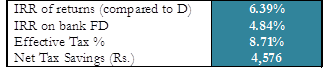
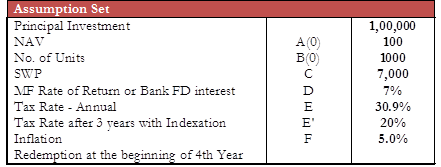
The concept here is that the debt MF has an effective p.a. rate of return (which is equated to a bank FD rate, or the opportunity rate) and we decide to withdraw a specific amount (SWP) every year. And the entire corpus is withdrawn 1 day after the end of 3 years so that the investor falls under the tax bracket of 20% with indexation (beyond 1 day after 3 years would make no difference to the calculations). The end result being judged here is the effective tax rate on the debt MF which in the base case above is 8.71%. Remember, our benchmark is 30.9% which is the effective tax rate on bank FD. Lower tax incidence than this is a saving to the investor, also shown in value terms (Rs. 4,576) above for a Rs. 1 lakh investment.


One trivial case is to set the SWP to 0, which means we are withdrawing the entire investment in bulk at the end of 3 years, and this case would get the lowest tax incidence because no capital gain is getting taxed at the effective rate of 30.9%. Just that that may not be the goal of many investor and the purpose of the whole exercise is to find an alternative to that.

Remember, this model would serve limited purpose in case a very high amount of the original investment is redeemed before 3 years, because in that case, returns are taxed at 30.9%. Mathematically as long as even a small amount is not redeemed after the third year, the return would be superior to bank FD but the gains would not be much. The idea here is to suggest an option wherein ‘some’ periodic cashflows can be generated with some tax savings.

Scenarios are presented below:

   
Some notes from the scenarios:
  1. The left top-most cell in first scenario table shows 0% tax incidence because here no amount is withdrawn and rate of return is same as rate of inflation (assumed), thus there would be nil gains after indexation.
  2. As SWP amount increases, tax incidence increases because greater amount falls under 30.9% tax rate.  
  3. For higher MF return rate also, tax incidence percentage increases because we generate higher returns than the inflation rate which increases the post-indexation gains.  
  4. Our benchmark IRR on bank FD is 4.84% (7% * (1-30.9%)) and each of the case above would give a higher IRR.

To conclude, I have presented a case wherein one can generate higher post tax returns from debt MFs. Agreeably, this works in specific scenarios and may not make an attractive proposition from every investor - especially those looking to increase returns in shorter investment horizon. But it does for me.  

Tuesday, 26 September 2017

Power & Pride

I like to read about - articles and interviews - successful people. In any field - sports, movies, arts, business. It is a much better learning experience than reading self-help books, listening to motivational gurus, or worse, following any Godman. Genuine achievements give semblance of authenticity and trust to what successful people say, unlike in case of others, where it may be empty talk. Also, there is greater objectivity as there is scope of judge, in my mind, the veracity or lack thereof of what such public personalities say.

The quality of an interview depends on the the questions asked. Many interviews are sycophantic, turning into advertisements. They are structured to glorify a cause or the person. Or the interviewer is subservient, fearful of posing uncomfortable questions. This is emphatically true in case of the Indian media, partly as a result of our tendency to accord divine status to celebrities, thus above all reproach; as well as our innate difficulty in challenging authority - deserving or perceived.

Now that I have rambled, let me come to my core issue. When I see interviews of successful people, I wish the interviewer would ask a personal question - “How do you handle power, money, and pride”. Facets of money, power and the arrogance that comes with it engrosses and perplexes me. A famous quote goes “Power tends to corrupt, and absolute power corrupts absolutely”.

Power is the ability to influence or to control. As per me, power has three possible sources - a) Money, b) Position, and c) Knowledge, talent or artistic skill. All the three sources of power that I enlist can be used constructively and for ‘greater good’, if there is such a thing. The power derived from ‘knowledge’ or ‘talent’ has fewer instances of being abused - Hiroshima bombing being a real-life example apart from all the mad scientists in Marvel comics. But power derived from money and position is summarily abused. The thing is that the line between good use and abuse of power is blurred. It is a difficult balance, to me, almost beyond the control of humans.

Over time, the societies have come to accept abuse of power as human nature. It is an elevated level of thought and consciousness to not implicitly accept abuse of power. I am not sure if any society has achieved that level of consciousness. Indian society has indeed not. The extent to which we expect and accept abuse of power is startling. Some part of it flows from the fibre of this society where people in power are exalted - what I call the ‘mai-baap’ syndrome. Indian population can be extremely subservient to those in power which induces abuse of power (just like how many famous rock stars easily fall into the trap of womanising because female fans willingly throw themselves to them). And the expectation of power-abuse has only deepened over the years. It is assumed that a politician would use his time in power to amass disproportionate amount of wealth; that near and dear ones of those holding prominent positions would secure jobs/contracts easily. It is only when power abuse goes to criminal extent that we are jolted (that too not always), else we are ok.

I find the Indian society increasingly obsessed with money. While there are communal and geographical disparities to this, the community I inhabit has nauseating obsession. Money is important - to have material comforts, for good health, for peace of mind, for freedom, both mental and physical. I don’t deny that poverty is a bane. But the distinction is not between poverty or absence of it, it is rather about the greed for more wealth. Indian society is increasingly placing greater premium on wealth above all virtues. Virtues like honesty, integrity, determination, courage, knowledge, wisdom, benevolence, lawfulness, charity are losing importance to the power of wealth. And increasingly, the society is comfortable with it. There seems to be no conscious repentance for this behaviour. Again it is not about willingness to live in poverty, instead it is about senseless greed. The line between the two is thin and it is hard for a person to know when he has transitioned from running away from poverty to chasing wealth. As the lifestyle expands with wealth, the definition of poverty changes. What was luxury yesterday becomes a necessity today. Nevertheless, I believe that man, as a conscious being can distinguish between the two. But there is a another aspect to this - whether your society places wealth at the high pedestal, it judges those without it as non-ambitious or failure. Then an individual’s choice is limited but to get into the race.

In the world I inhabit, it is very usual and expected that any interaction between two individuals entails each judging the other person’s wealth. Cues such as attire, gadgets, jewellery, vehicle, address etc. are closely noticed. Because wealth can be so easily quantified, analysed, trended, it is a much better tool (than other intangibles) to compare people, to rank order, to compete, and to define success and failure. To many Indian readers, this may seem like harping on the obvious. I have met so many people who get appalled when I mention this, the look on their faces saying “Isn’t it obvious?”, “What’s wrong with it?”, “You are naive”. Indeed, I feel naive very often. But I have read enough that this has not always been the state of affairs. Many societies - Indian and others - have at some point attached importance to ideals other than money. Infact, amassing wealth had been viewed as abominable by many.

The hatred of chasing money can have two interpretations - a) genuine hatred and belief in valuing higher virtues, and b) false hatred emanating from weakness of character - hatred for money or money-grabbers because oneself is not capable of it. I am not sure where I fall.

Agree that there is a degree of virtue also in chasing money - it gives birth to ambition, which can be the seed for many good things including progress. Many industries, and businesses owe their existence and success to somebody’s desire to become rich. These businesses serve the needs of the society as well as uplift people out of poverty. It is hard to imagine how the civilisation would have advanced had the humans not been greedy. At the same time, I have two counter arguments -
  1. At the heart of most progress is the desire to solve a problem, to innovate, to make things better and to help humanity at large. That is when society gains the most.
  2. Even if greed is at the heart, it should stop up to a point, after which other virtues should take greater importance (similar to the ashram system proposed in Hinduism). What that level is highly subjective and difficult to define for most people.

To expand the second point above, the problem is not with chasing money - it may be a greater travesty to not do justice to one’s ability. The problem is chasing money at the cost of higher virtues. Chasing money inherently breeds vices, narrows thought, weakens and distorts people out of their natural form, takes pleasure out of life as it is, consumes mental space with constant comparison and envy, prevents appreciation of non-material virtues in others. All a result of the power that the money allows them.

Power, as I said, can also come by way of a position or rank and that too is an attraction for many. Many positions in bureaucracy or in state-owned companies do not give great financial rewards (at least not legally) but compensate for the same by way of positional power. The universal love for recognition makes people crave a position of power, often not realising that the appreciation or acknowledgement that they are getting is just for the position and not for the position-holder. While positional power and monetary benefits go hand-in-hand, but holding a position of influence can be intoxicating even without any monetary gains. Just having control over other people, to be able to make decisions which can significantly impact lives - make them or mar them, can be heady. So many despots have been driven purely out of obsession to decide others’ fate.

Development of my consciousness - reading of history, state of current politics, personal experiences and ruminations - has made me hateful of power. Consequently I am wary of having any power, or appearing to exercise any power, at the expense of appearing meek, and naive. Still I got a position of power - chairing a committee in my organisation. The committee enjoys a fair degree of authority - people make presentations to this committee on which it makes decisions - cross questioning presenters, and having the luxury to disregard their opinions. I have been a presenter in front of such committees and was conscious of the arrogance that creeps into the committee members at times. So I was very wary of how I conducted myself when I became the chairperson of the committee. It has been more than a year and I am not happy with how I have done. Despite my best attempts, I get swayed when I am sitting in that committee. I would get aggressive, challenge the presenters, or other committee members, get angry, irritated and restless. While I can fully defend the intent and rationale of my conduct, I cannot defend the conduct itself. I want to be more measured, control, and in more control of my emotions. But I have not been successful. In the end, this constant duality of trying to behave in a particular manner but still getting influenced has made me detest the committee. The fact that I, despite being aware of it, am not able to control abusing it, has made me more conscious of how difficult it is to manage power, especially for those who have much more of it then me.    

With power comes pride - one of the seven deadly sins. The latin for pride is Superbia and it has both positive and negative connotations. The difference between the two is thin and it is difficult to maintain the balance. At its worst, pride is downright ugly. Better words to describe the ugly connotation are hubris, conceit, haughtiness, arrogance, superciliousness. Arrogance comes readily even from the perception of having power. And this perception can be immediate as well as transitory. Few people have absolute certainty and confidence in themselves, irrespective of the circumstances. Mostly, the sense of power is relative. So, in India, people are usually arrogant to those who serve them - in restaurants, toll booths, flights etc. - driven by a sense of material superiority because they are paying for the services. Despite understanding it, I am never able to accept the arrogance that people acquire when they think they are in power. Few people are able to maintain humility and grace even when they hold any power. And talking about virtuous behaviour, one can go beyond humility. Instead of chasing more power for oneself and at the expense of forsaking virtues, setting poor examples for others, it would be refreshing if powerful people used their power for public good. In India, this seldom happens, my favourite examples being - big film stars not willing to stand behind genuine causes or to promote their craft, sportsmen not voicing opinions freely when they see rampant corruption in sport administration, businessmen not promoting fair practices or doing enough for upliftment of the society. Most powerful people in India fail to realise the inherent responsibility of power, basking only in its privileges.

Wednesday, 23 August 2017

A Social Movement

I have a lasting memory of a message from an advertisement that I had seen long back. It used to air on Doordarshan, the government-owned, free-to-air channel, which for many years was the only channel on Indian television. It was a social advertisement persuading people to stop using silk products, primarily sarees, in order to save the lives of silkworms, huge amounts of whom are killed in the silk-making process. Without getting into the moral and ethical considerations of the appeal, what struck me was how the advertisement sought to hurt an industry by impacting its demand, by appealing to the user base, comprising a large population. Another similar example is the appeal to verify that the diamonds one purchases are not ‘blood diamonds’ so as to prevent ruthless mining of such diamonds in poor African countries by terrorists and mafia in order to fund their ammunition. Such mining involves severe child and human rights abuse. Here too, given the social, political, and economic challenges and the bloodshed that would entail in solving the problem directly i.e. by confronting such mafia/terrorists, the more peaceful and certain solution is to cut the demand itself.

Both the examples solicit commitment of a large group where the members do not know others but are bound by a common behaviour and are thus being mobilised to achieve a common goal. I call this a ‘Social Movement’ and I find it to be a powerful yet peaceful tool to achieve a common good. Importantly, it is not a mob where individuals would come together physically to achieve a purpose, mostly nefarious. Because members of the group are not physically together rather connected by virtue of being user of a product or service, such a movement thrives on an individual’s choice irrespective of how the other members choose. If everyone starts to think that: “Why should I respond to the appeal, nobody else may be responding”, the movement fails all together. That is what makes such a movement difficult to take off. It requires people to abstain, to sacrifice something and most people would resist being the only one to sacrifice. It requires an individual’s moral commitment and conscience regardless of any peer support or validation.

Around me, I see numerous situations where I feel such a social movement can be applied and could achieve astounding results. One ready example - near my home a vendor of street food puts his portable stall every evening on a busy side street adjacent to a busy main road. The peak traffic time is also the best time for his business. People of all kinds - in cars, on tw0-wheelers, or even cycles stop at the stall. Over time, it has become very popular. The stall itself obstructs one lane of the two-laned street. In addition, those visiting the stall park their vehicles either on the main road or on the street. All this causes traffic jams and chaos, with those having nothing to do with the stall bearing the brunt. I find the state of affairs deplorable. I am sure those parking their vehicles at the stall are to be blamed, but the root of the problem is the vendor himself who has no business being there. Another instance involves a fruit juice vendor near a bus stop, effusing fumes, waste-water, and litter - all for consumption of those waiting at the bus-stop. And then there is the case, not of a small-time vendor looking to make a living, but instead of a big sweet-shop. The shop has monopolised the service road as well as the pavement separating it from the main road. Throughout the day, these spaces are filled with materials of use to him - packing stuff, raw material for his sweets, trash bags, vehicles which take hours loading and offloading, rendering the pavement and the service road unusable for common public and vehicles.

All examples are of somebody exploiting public spaces and resources for personal gains, in the process causing harm and discomfort to common users. I am sure there are plenty such instances across this country. Invocation of the judiciary is one way to curtail this menace. But I think some representatives of the legal system are taken on board by the perpetrators. Thus a complaint by a well-minded citizen like me may not have much effect - in fact I may invite trouble for myself by doing so. So for those, who like me, are weak to approach the legal system, the social movement I highlighted above can be useful. At personal level, I have vowed never to buy products from any of the vendors I have mentioned above. My argument is that I am not giving business to people who follow unethical or illegal practices.

As the examples show, I am not directly getting impacted by the perpetrators, at least not materially. Still I take this stand - for the sake of it. This can be an important aspect of the social movement - one takes part irrespective of whether she is directly impacted. Also, this movement requires a tacit understanding, an invocation of the moral conscience of the society It requires people to be conscious without having to be roused. Of course, one (say I) can actively mobilise the movement by appealing to people, distributing pamphlets, letting the word spread etc., instead of relying on the self-realisation and activism. But I feel challenged to do that.

I persist with this movement at my individual level, and I have found many applications. So I refuse to consume products from company where I know that the promoters have been corrupt and malevolent; refuse to watch movies of actors who are facing judicial enquiries for some crime; can’t support sportsmen or sports bodies with corruption charges. I find it difficult to support any political party because I find all of them tarnished. I agree that some of these instances take idealism and self-denial to exaggerated proportions, but my conscience is more comfortable. I am also conscious of the fact that I may be unconsciously consuming products or services of entities which may not agree to my exacting standards and that it may be difficult to survive by following the dictum accurately. That I should be doing a thorough due diligence before buying or supporting anything. But I do what I can.     

Self-realisation to a common goal for a large population without being brought together requires highly evolved social structures and thought process, the kind very few, if any, society can boast of. What I am talking about is a situation where the law enforcement is ineffective and the society decides to non-violently and economically punish wrong-doers, a form of Gandhian non-cooperation. I know I am likely to witness disappointment in this expectation - no wonder I have seen the food vendor and the sweet shop flourish.


PS: after posting this piece, I read somewhere that in choosing between morals and economics, economics would always win. I agree and that is why I accept that social revolutions as I have postulated here will not work for many issues where competition is from economically beneficial choices (meaning cheaper, easier, faster). At the same time the instances I have given here do not necessarily pit morals with very superior alternatives. In most of the examples, if people were to stick to some morals, they would not be too worse off. Slightly inconvenienced yes, but nothing significant. It is more of a social lethargy. That is the crux of my issue - we cannot pay even a small price, or take the smallest of leaps for big social gains.

Monday, 21 August 2017

National Anthem during movie

This piece has numerous quotations from famous men. Despite many iterations, I could not reduce further. To be sure, my thoughts on the subject have not been influenced by these quotes, if anything, the quotes have been chosen to reaffirm my views. Thus the selection is biased. While I am sure there would be many quotations to the contrary from equally worthy and distinguished people, these are chosen to convey my thoughts on the subject. To read only the quotes and skip the text would not be the worst idea.

“You'll never have a quiet world till you knock the patriotism out of the human race.”
― George Bernard Shaw

What is patriotism? Online dictionary definition is: “Having or expressing devotion to and vigorous support for one's country.” For me, this definition has some problems. First, does the support have to be vigorous? How does one measure vigour? Does less vigour mean less patriotism? Second, how does one define a person who is not devoted and not vigorously supporting? Is he a ‘traitor’? Or can one be apatriotic? Is there even such a term? I have often pondered on patriotism. Is it a virtue and is it a necessary virtue? When we are young, love for the country is imbibed into us by way of songs and stories of country’s glory. (In cases like mine, it may not be so much a part of upbringing at home.) As we grow older and start to think, we question many things including patriotism. My thought process on this topic has evolved on multiple lines -

In my personal experience I have not found many patriotic people. Largely that has to do with the social surrounding. I feel, in India, patriotism is not uniformly distributed, rather it follows racial or geographical lines. If presence in the armed forces can be used as a proxy for degree of patriotism (I know it is far from perfect, but a crude proxy), Indian armed forces has significantly higher representation from Punjabis, Jats, people from J&K, Himachal Pradesh, Gurkhas, Marathas, than say Gujaratis, Bengalis, Oriya, Biharis or the Baniya communities populating the states of Rajasthan, and Madhya Pradesh. I come from the Marwari clan (a Baniya community) and I doubt there would be many marwaris in armed forces (too self-centered, risk-averse where physical safety is concerned and focused on amassing wealth). Like many other virtues, for Baniya, patriotism is a fine trait, but only when followed by others. In my community I have never come across anyone or even heard anybody display any act of valour. Outside my community as well, I have heard few stories of people in the armed forces. I suppose it is usual - Indian armed forces including paramilitary forces has strength of 4-5 million which is less than 0.5% of the population. Nevertheless, to me patriotism has largely been a distant concept. It is a bit unnerving when one reads of families dedicating generations to armed forces, or of stories of how selflessly people fight in wars. I have developed a cynicism towards patriotism, part of which is justified as I would elaborate further.  

“There is no flag large enough to cover the shame of killing innocent people.”
― Howard Zinn (American historian, playwright, and social activist)

“He who joyfully marches to music rank and file has already earned my contempt. He has been given a large brain by mistake, since for him the spinal cord would surely suffice. This disgrace to civilization should be done away with at once. Heroism at command, senseless brutality, deplorable love-of-country stance and all the loathsome nonsense that goes by the name of patriotism, how violently I hate all this, how despicable and ignoble war is; I would rather be torn to shreds than be part of so base an action!”
― Albert Einstein

“Patriotism is the virtue of the vicious”
― Oscar Wilde

“The notion that a radical is one who hates his country is naïve and usually idiotic. He is, more likely, one who likes his country more than the rest of us, and is thus more disturbed than the rest of us when he sees it debauched. He is not a bad citizen turning to crime; he is a good citizen driven to despair.”
― H.L. Mencken (American journalist, satirist, cultural critic)

“All wars are civil wars because all men are brothers... Each one owes infinitely more to the human race than to the particular country in which he was born.”
― François Fénelon

“Patriotism is the last refuge of a scoundrel.”
― Samuel Johnson (English writer, poet, essayist, moralist, literary critic, biographer, editor and lexicographer)

“What struck me as I began to study history was how nationalist fervor - inculcated from childhood on by pledges of allegiance, national anthems, flags waving and rhetoric blowing - permeated the educational systems of all countries, including our own. I wonder now how the foreign policies of the United States would look if we wiped out the national boundaries of the world, at least in our minds, and thought of all children everywhere as our own. Then we could never drop an atomic bomb on Hiroshima, or napalm on Vietnam, or wage war anywhere, because wars, especially in our time, are always wars against children, indeed our children.”
― Howard Zinn, A People's History of the United States

“If our country is worth dying for in time of war let us resolve that it is truly worth living for in time of peace.”
― Hamilton Fish (American statesman and politician)

“Patriotism is a kind of religion; it is the egg from which wars are hatched."
― Guy de Maupassant, The Complete Short Stories Vol. 2 of 3

“My wariness of patriotism comes from the tribalism that creeps alongside it and the Us and Them divisions it inevitably creates. There's an undeniable appeal to tribal membership, of course. We all want to be part of the club, however we define it.”
Chris A. Smith "Angels, Protesters and Patriots: What a Long-Ago Skirmish Says About Love of Country", California Magazine, March 29, 2016

Does patriotism imply violence? I think the whole concept of patriotism has been introduced and enforced to mobilise people to protect territories. What is the concept of a nation-state? Or a country? Ever since man turned from a hunter-gatherer to an agriculturist, the concept of owning and protecting a territory gained root. Man is a social animal but he is not boundlessly social - one tends to conjoin with certain kinds. Starting with a family, the concept snowballs into a locality, a community, a village, a town, a state and ultimately a country. That is largely where the affinity stops (only attack by aliens may unite us). Even animals exhibit preservation of territory. It is largely this love of territory - what is mine, that is exalted to patriotism. And preservation of territory requires violence - against outsiders, invaders. Greed in humans means that he wants more than what he has and that extends to land. Since earliest history, men have tried to amass land - apart from the economic prosperity or access to something specific (gold, timber, fertile soil, water, iron, cotton), size of one’s territory has been a sign of strength. This implies a territory and its natives are constantly under threat from invaders and thus it is necessary to protect it (imagine if someone pitched his tent in your home, you would surely turn to violence). So violence is at the core of patriotism. Turning the coin, patriotism is an easy tool to invoke and justify violence. And there have been many instances when this has happened.     

“Patriotism is a double-edged sword. It both emboldens the blood and narrows the mind.”
― Anonymous

“Patriotism: Your conviction that this country is superior to all other countries because you were born in it.”
― George Bernard Shaw, The Public: A Journal of Democracy, 1910

Patriotism is like a faith and just like faith can make one blind, so can patriotism. It narrows thinking. It can force one to accept without questioning. It is very easy to slip from patriotism to jingoism. This is readily seen in the world everyday when people fall readily to the cry of patriotism by some partisan leader without considering the merits. And the love for the country is so deeply embedded that patriotism becomes a very potent and dangerous tool. Even educated, free thinkers feel weak to speak against a foul-cry of patriotism.

“I love America more than any other country in the world and, exactly for this reason, I insist on the right to criticize her perpetually.”
― James Baldwin (American writer and social critic)

“The greatest patriotism is to tell your country when it is behaving dishonorably, foolishly, viciously.”
― Julian Barnes (English writer), Flaubert's Parrot

“Patriotism is a lively sense of collective responsibility. Nationalism is a silly cock crowing on its own dunghill and calling for larger spurs and brighter beaks.”
― Richard Aldington (English poet and writer), The Colonel's Daughter

Patriotism is proud of a country's virtues and eager to correct its deficiencies; it also acknowledges the legitimate patriotism of other countries, with their own specific virtues. The pride of nationalism, however, trumpets its country's virtues and denies its deficiencies, while it is contemptuous toward the virtues of other countries. It wants to be, and proclaims itself to be, "the greatest," but greatness is not required of a country; only goodness is.
― Sydney J. Harris (American journalist), Pieces of Eight

“Patriotism is when love of your own people comes first; nationalism, when hate for people other than your own comes first”
― Charles de Gaulle

“Such then is the human condition, that to wish greatness for one's country is to wish harm to one's neighbors.”
― Voltaire

I feel true patriotism should allow one to say that my country is not good at something or even that another country is better. Just like in most aspects of life, appreciation of somebody better is accepted, why not within countries. Why can I not say that this is the problem with my country and another is doing much better job than ours. Increasingly in India, it is seen as anti-national. It is seen that criticising something demeans it, or weakens it, without even going into the merit of the criticism. It is a perfect ostrich approach in which entire India is engulfed. While we are not an autocratic country and there is a degree of tolerance for the unpopular and dismissive cries, but that tolerance seems to be waning. There have been numerous incidents when dissidents to patriotic virtues, in the field of arts, literature, politics, are being marginalised and criminalised. Words like Nationalism and anti-National are easily thrown around.

“I saw courage both in the Vietnam War and in the struggle to stop it. I learned that patriotism includes protest, not just military service”
― John F. Kerry

“How does one hate a country, or love one?... I know people, I know towns, farms, hills and rivers and rocks, I know how the sun at sunset in autumn falls on the side of a certain plowland in the hills; but what is the sense of giving a boundary to all that, of giving a name and ceasing to love where the name ceases to apply? What is the love of one's country; is it hate of one's uncountry? Then it's not a good thing.”
― Ursula K. Le Guin (American author), The Left Hand of Darkness

To take this further, it is unpatriotic or even seditious to say that another country is better. It is unpatriotic even not to criticise and speak against, vehemently and vociferously, certain countries, who are rivals. This brand of patriotism thrives on appearing superior by making others inferior. In India, “My country great” is a common refrain. So it is to pull down the British for colonising us, Pakistan for its very existence, most of western countries for their supposed cultural vacuity, African countries for their relative economic weakness and colour. It is all very neat - those who are inferior are easily dismissed, and those who are economically superior we play the culture argument, that too largely perceived and on many occasions devoid of facts.   

“People who enjoy waving flags don't deserve to have one”
― Banksy (anonymous England-based graffiti artist, political activist and film director of unverified identity), Wall and Piece

“Identification with the rag called the national flag is an emotional and sentimental factor and for that factor you are willing to kill another - and that is called, the love of your country, love of the neighbor . . .?”
― Jiddu Krishnamurti (Indian philosopher, speaker and writer)

“Patriotism is like religion - it is best when least ostentatious.”
― Charles E. Jefferson, "Ethical Aspects of Conscription and the War"

“Patriotism is being refashioned as a performance sport. It is not a feeling, it is an act, and it has to be performed in public view over and over again.”
― Sandip Roy, Huffington Post, March 21, 2016

The kind of patriotism that India is focused on is presentative. And given our love for superficiality, we are accepting it with glory. It is the latest buzzword, a fad, a brand which somebody has decided to peddle. The millenial population of this country is largely devoid of thought, unaided by the poor education system, lacks focus, has short attention span, is consumer of instant sensory pleasure, and is aspirational only for material gains. Thus it is easy to peddle most things as fashion and patriotism too falls in that bucket. At one point we had a law which prohibited waving the national flag at civilian houses or vehicles. The argument was that it tantamounted to, or at least led to, the possibility of disrespect of the national flag. The law made no sense and a few years back the restriction was removed, following a Public Interest Litigation in the Supreme Court. So now one can easily put the national flag on vehicle, at house or hold it anywhere. Good, respectful and patriotic all. But it is becoming too showy, too pretentious. In another recent development, it is mandatory to play the national anthem before the start of a movie in cinema halls. While it is not said, I think it is by dictum of public conduct, essential to stand during the playing of the anthem. Again all showy for me. It was recently decided by government universities to hoist the national flag in campuses, possibly to counter the rising tide of anti-nationalism amongst youth. Whatever happened to free will, free speech, free thought? It is like patriotism is being stuffed down the throat; nationalism is a software program to be installed. In India it is common to give the argument of ‘impressionable minds’. That every non-adult is under a threat of being impressed upon with evil/seditious/anti-nationalistic thoughts and it is essential to guard them against these through brute force. Thus it is essential to have flags all around. To stop all flow of information which is inglorious for the country. My only argument is against the use of ‘force’. I should have the freedom to act the way I like - stand to national anthem if I like and sit if I do not. Not giving respect should not be counted as disrespect. And I should have the freedom to form and own my opinions.

“Patriotism … is a superstition artificially created and maintained through a network of lies and falsehoods; a superstition that robs man of his self-respect and dignity, and increases his arrogance and conceit.”
― Emma Goldman (anarchist political activist and writer)

“So I wonder why patriotism is judged by words and not deeds? Why are slogans more important than solutions? …. I wonder why we are not asked to display our nationalism by being told to harvest rain water, use less plastic, and recycle so that we actually nurture our land, instead of just paying lip service and bandying a few words around.”
― Twinkle Khanna

“Patriotism is a sore subject with me. We have the flag-waving loudmouth patriot who never sacrificed a thing for this country. We have the sidearm-carrying patriot who thinks playing cowboy is a substitute for patriotism. We have the moneyed, connected types who automatically consider themselves patriots. We have people who had a great-great-grandfather who ... and on and on and on.”
― Paul Sypek, "Missing The Character Of True Patriotism", Hartford Courant, March 28, 2016

Is saluting the national flag, standing while playing of the national anthem, or even singing it along, the most patriotic thing? This is where patriotism in India largely starts from and ends. I am sure many of those who diligently respect the national anthem in a cinema hall, and even look sternly at those who do not, would push and jostle to get out of the hall once the movie is over, would try to rush out of the parking lot, honk ceaselessly on the road, jump red light if required, try to bribe the policeman if caught, throw garbage in public places, try to jump the queue at the entrance of restaurant, work air conditioners of home on stolen electricity, mistreat their maids or attendants of any kind. And these are just minor offences - the same people would evade taxes, thrive in and advance the culture of corruption in their businesses or professions, allow their minor kids to drive vehicles on the road rashly and even injure a few people, be least concerned about reducing the air and water pollution. These same people would adulterate food that harms and kills millions, make poor roads on which people die in accidents, sell spurious medicines, occupy seats of power on sheer muscle and financial strength at the expense of deserving people, attack foreigners of particular nationality or colour if it does not suit their tastes or sensibilities, allow mounds of garbage to pile up as long it is outside the gated societies they live in. In their conduct, the focus is solely on the safety and prosperity of self, family and dear ones. Or if they are slightly more socially aware and responsible, than they work for their religious or caste groups. Which itself might involve pulling down other religions and castes. And of course, a large part of them would profess patriotism on social media, proudly forward messages, even wear the team shirt and bash the arch-rival Pakistan during a cricket match. Patriotism in India is mere public lip service while actual efforts are too difficult and inconveniencing - best left to somebody else.   

“....The gospel of the monarchical patriotism is: "The King can do no wrong." We have adopted it with all its servility, with an unimportant change in the wording: "Our country, right or wrong!" We have thrown away the most valuable asset we had: the individual's right to oppose both flag and country when he (just he, by himself) believed them to be in the wrong. We have thrown it away; and with it all that was really respectable about that grotesque and laughable word, Patriotism.”
― Mark Twain

“The love of one's country is a splendid thing. But why should love stop at the border.”      
― Pablo Casals   
Buran Ghati – a personal memoir

  (Written over 19-24 June 2025)     Phew! I have to write this. Buran Ghati was my fifth trek. And the fifth one with P and NS. Someone...